You're exhausted. Another Monday, another blank screen, another demand for "fresh" content. You've been on the content treadmill for months—maybe years—and you're running out of ideas.
Here's the secret that prolific creators won't tell you: they're not creating as much new content as you think. They're recycling their best stuff. Strategically. Repeatedly. And it's working.
The Burnout Trap
There's a pervasive myth in social media marketing: you need to create something new every single day. Original thoughts. Fresh takes. Novel ideas.
This is a recipe for burnout.
The truth? Your audience didn't see most of what you posted. Algorithms showed your content to maybe 5-10% of your followers. People scrolled past. Life happened. That brilliant post you spent two hours crafting? It lived for 24 hours and disappeared into the void.
Meanwhile, you're already stressing about tomorrow's content.
Enter the 80/20 Rule
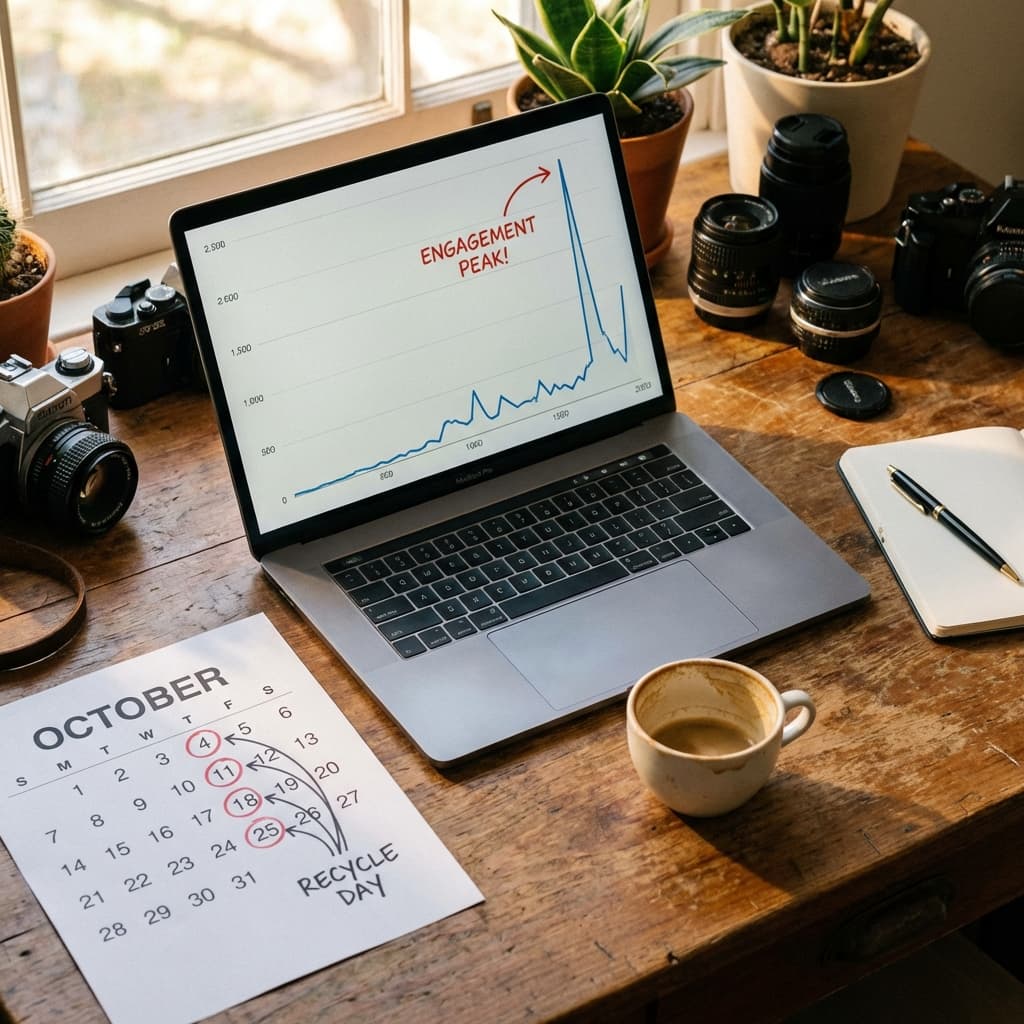
Here's what the data consistently shows: roughly 20% of your posts generate 80% of your engagement. You already have a handful of content pieces that resonated deeply with your audience. They sparked conversations. They got saved. They got shared.
These aren't just old posts. They're your content goldmine.
The problem is most creators treat content like a disposable resource. Post it once, move on, never look back. But your best ideas deserve a longer shelf life than 24 hours.
How to Find Your Winners
Before you can recycle content, you need to know what's worth recycling. Here's how to run a quick audit.
Go back through your last 3-6 months of posts across all platforms. But don't just look at likes—likes are vanity metrics. Instead, focus on saves (people wanted to return to this), shares (people thought others needed to see this), and comments (people felt compelled to respond). These are the signals that content truly resonated.
Look for patterns. Maybe your "how I failed" stories outperform your success posts. Maybe your contrarian takes get ten times the engagement of your tips. Maybe carousel posts crush your single images.
Separate the timeless from the time-sensitive. A post about "Q4 marketing trends" expires. A post about "why most content strategies fail" is evergreen. Focus your recycling efforts on the evergreen stuff.
The Art of Recycling (Without Being Lazy)
Recycling doesn't mean copying and pasting the same post every month. That's lazy, and your audience will notice. Smart recycling means transforming content while preserving the core idea.
Refresh it. Update the statistics. Swap in a recent example. Sharpen the hook based on what you've learned since you first posted it.
Reformat it. That text post that performed well? Turn it into a carousel with visual breakdowns. Or a video where you expand on the idea. Or a thread that goes deeper. Same insight, new packaging.
Replatform it. Your LinkedIn audience isn't your X audience. A post that crushed on one platform might be completely new to followers on another. Adapt the tone and format for each platform's culture.
Reframe it. Take the same core idea but approach it from a different angle. "Why consistency matters" becomes "Why I stopped posting daily" becomes "The real reason your engagement is flat." Three posts, one underlying truth.
Building Your Rotation System
Random recycling is chaotic. You need a system.
The 30-60-90 approach works well for most creators. After a post performs well, flag it for recycling. At 30 days, repost it on a different platform or in a refreshed format. At 60 days, bring it back to the original platform with updated framing. At 90 days, consider a major transformation—turn a post into a thread, or a thread into a video script.
Create a "greatest hits" folder. Every time something performs above your average, save it. Screenshot it. Add it to a spreadsheet or note. This becomes your content library when you're stuck or short on time.
When planning your content calendar, mix fresh content with recycled content. A good ratio to start: 60% new, 40% recycled. You'll maintain variety while dramatically reducing your creative burden.
"But Won't People Notice?"
This is the fear that stops most creators from recycling. What if someone calls me out? What if I look lazy?
Here's the reality: the average social media user follows hundreds of accounts and scrolls through thousands of posts. Studies suggest your followers see less than 10% of what you post. That "repeat" content? Most of them are seeing it for the first time.
And your newer followers definitely haven't seen your greatest hits from six months ago. Why deprive them of your best thinking?
Even your most loyal followers won't mind. People re-read books they love. They rewatch favorite movies. They revisit ideas that helped them. If your content is genuinely valuable, a reminder is welcome—not annoying.
The only people who might notice are other creators who are studying your feed obsessively. And honestly? They're probably recycling their content too.
Start Today
You don't need to create more. You need to leverage what you've already created.
Here's your homework: open your analytics right now and find your top 5 performing posts from the last quarter. Look at the engagement patterns. Identify which ones are evergreen. Then pick one and schedule a refreshed version for next week.
That's it. One recycled post. The start of a sustainable system.
Your best ideas aren't behind you—they're waiting to work for you again.
Tired of the content treadmill? Broadr helps you schedule, recycle, and manage your social media without the chaos. Try it free and put your best content back to work.