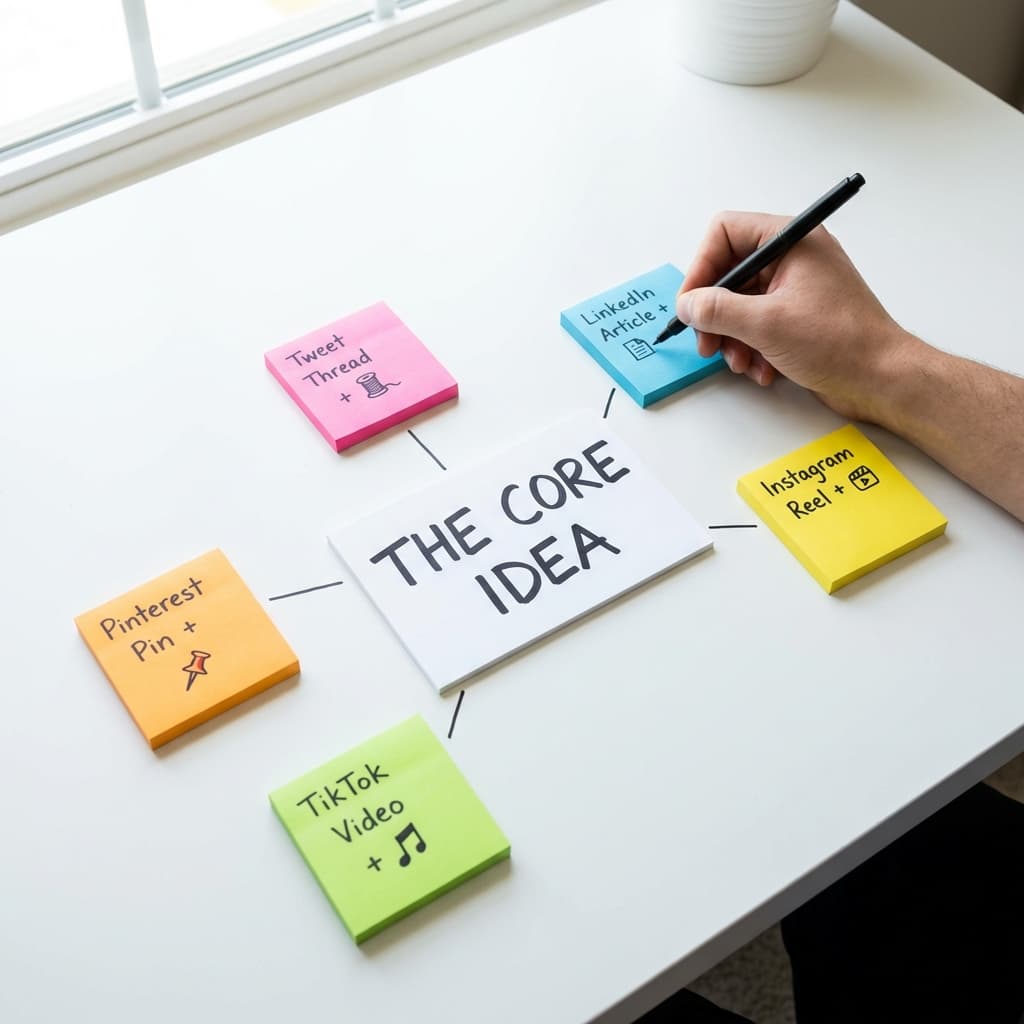
You don't have an ideas problem. You have a repurposing problem.
That post you spent an hour on? It probably contains 3-5 additional posts waiting to be extracted. But instead of pulling them out, you moved on and started from scratch the next day.
This is why content creation feels like a treadmill. Every day, you're hunting for something new when you're sitting on a goldmine of content you already created.
Let me show you how to fix this.
The Single-Post Trap
Most creators treat every post as a standalone unit. One idea, one post, done.
But your audience didn't all see that post. Social media reach is brutal - maybe 10% of your followers actually saw it. And even those who saw it won't remember it in two weeks.
Professional media companies know this. They don't publish one article about a topic and move on. They publish the news story, then the analysis piece, then the opinion column, then the follow-up, then the "one month later" retrospective.
You should do the same. Not because you're lazy (though efficiency is nice), but because repetition with variation is how ideas actually land.
The Repurposing Framework
Here's the system. Start with one core idea - a lesson you learned, an insight you had, a process you use. Then extract five different angles:
Post 1: The Story
Tell the origin story. How did you discover this insight? What happened that made you realize it?
Example format: "Two years ago, I [made a mistake / had a realization / discovered something]. Here's what I learned..."
Stories are memorable. They give context. People share stories more than they share tips.
Post 2: The Listicle
Break the insight into numbered components. What are the 3-5 elements of this idea?
Example format: "5 reasons why [your insight] matters:
- [Point one]
- [Point two] ..."
Listicles are scannable. They work well on LinkedIn and Twitter because people can quickly assess whether it's worth reading.
Post 3: The Contrarian Take
What does conventional wisdom get wrong about this topic? Where do you disagree with the mainstream?
Example format: "Everyone says [common advice]. But here's why that's wrong..."
Contrarian takes spark discussion. They get people commenting, agreeing, disagreeing. Controversy (the professional kind) drives engagement.
Post 4: The How-To
Give practical, step-by-step instructions. How can someone apply this insight today?
Example format: "Here's exactly how to [implement your insight]: Step 1: ... Step 2: ... Step 3: ..."
How-tos get saved and bookmarked. They demonstrate expertise. They provide immediate value.
Post 5: The Question
Flip it around. Instead of teaching, ask your audience for their perspective.
Example format: "I've been thinking about [your insight]. But I'm curious - what's your experience with this?"
Questions drive comments. They make your audience feel included. And the responses give you material for future posts.
A Real Example
Let's say your core insight is: "Cold emails work better when you mention something specific about the recipient."
Post 1 (Story): "Last year, I sent 200 cold emails and got 3 responses. Then I changed one thing..."
Post 2 (Listicle): "5 ways to personalize cold emails that don't feel creepy:
- Reference their recent work
- Mention a shared connection
- Comment on their company news ..."
Post 3 (Contrarian): "Everyone says 'personalize your cold emails.' But most personalization is lazy and obvious. Here's what actually works..."
Post 4 (How-To): "My exact process for researching prospects before reaching out: Step 1: Check their LinkedIn for recent posts Step 2: Look for recent company news Step 3: Find a mutual connection..."
Post 5 (Question): "Cold email people - what's the best personalized detail you've ever received? Looking for examples beyond the obvious..."
Same insight. Five different posts. Each could be published on different days across the week.
Spacing and Platform Adaptation
Don't publish all five on the same day. Spread them across the week or across platforms.
The spacing approach:
- Monday: Story version (sets the stage)
- Tuesday: Skip (let it breathe)
- Wednesday: Listicle (different format, same idea)
- Thursday: Skip
- Friday: How-to (end the week with actionable value)
The platform approach:
- LinkedIn: Story and how-to (professional audience likes these)
- Twitter/X: Listicle and contrarian take (works well for threads)
- Threads/Bluesky: Question (more conversational platforms)
Your audience on LinkedIn isn't the same as your audience on Twitter. Posting similar content across platforms isn't redundant - it's smart distribution.
The "Why Don't I Sound Repetitive?" Question
You're worried people will notice you're saying the same thing. They won't. Here's why:
Different formats hit differently. A story resonates with some people. A listicle resonates with others. You're not repeating - you're reaching different learning styles.
Reach is limited. As mentioned, most of your audience didn't see the first post. The "repeat" might be their first exposure.
Repetition builds authority. When you say the same thing multiple ways, it reinforces that this is your expertise. You become known for this idea.
Time passes. By Friday, Monday's post is ancient history in social media terms. Nobody's thinking "wait, didn't they say this already?"
The only way to sound repetitive is to publish identical content multiple times. Formatting, framing, and angle make all the difference.
Tools That Help
When we built Broadr, we added a feature specifically for this: you can create a "content pillar" and attach multiple post variations to it.
Write your core insight once. Then draft the five variations and schedule them throughout the week. You can see at a glance how you're covering the topic from different angles.
But honestly, even a simple spreadsheet works. Columns for: Core Idea, Story Version, Listicle Version, Contrarian Version, How-To Version, Question Version. Fill it in as you create.
Your Next Step
Take your best-performing post from the last month. Open a doc. Write out these five headers:
- Story version
- Listicle version
- Contrarian take
- How-to version
- Question version
Sketch out each one. Don't overthink it - rough drafts are fine.
You just created a week of content in 30 minutes. From one idea you already had.
That's the power of repurposing. Less ideation, more leverage.